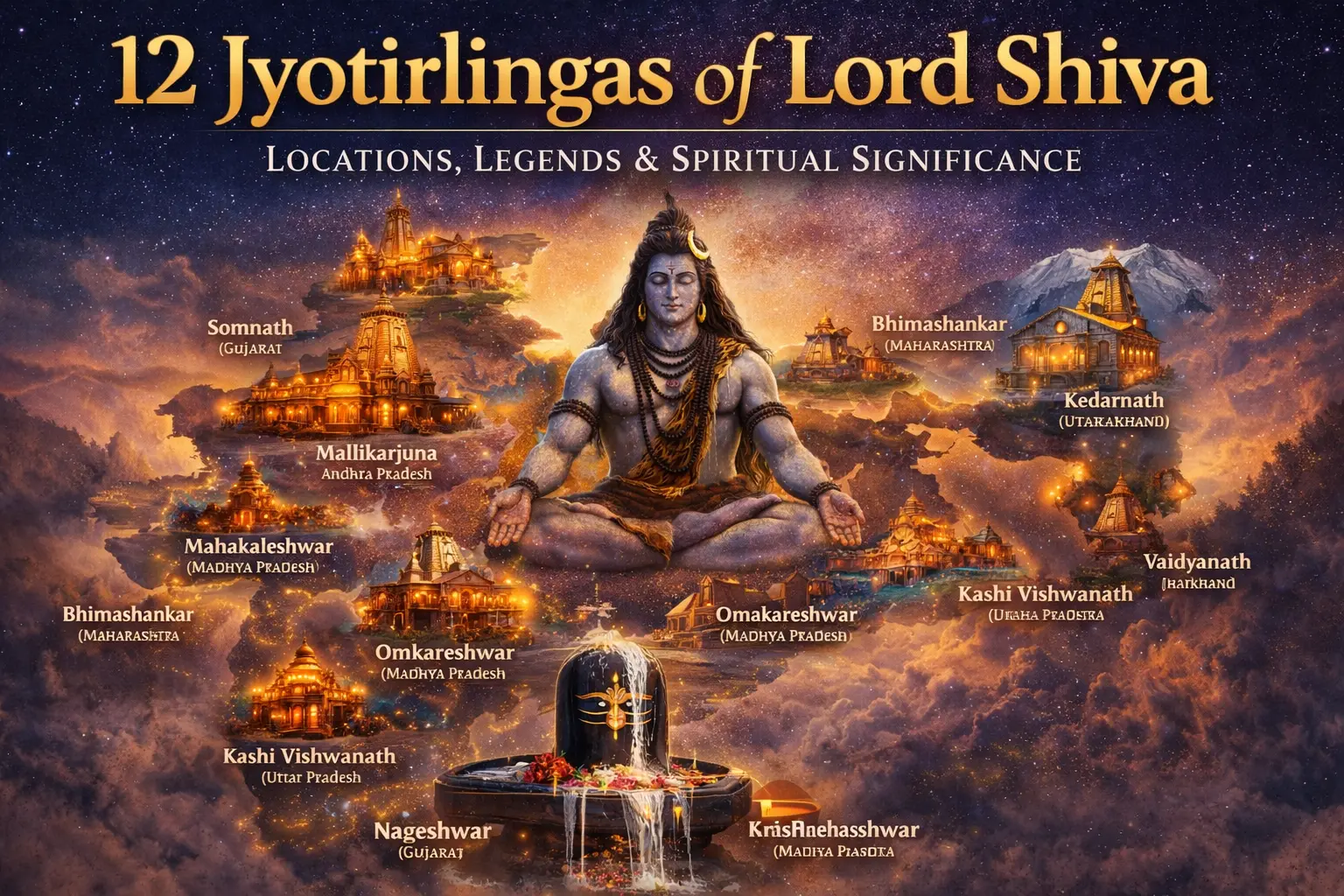
The 12 Jyotirlingas are the holiest shrines of Lord Shiva, said to be the spots where Shiva appeared as an endless piller of light (Jyoti). Located across India, the 12 Jyotirlingas are the spiritual foundation of Shaivism. These spots are visited by millions of pilgrims every year.
The 12 Jyotirlingas are mentioned in the ancient texts such as the Shiva Purana. The devotees usually pay a visit to these sites for an extremely transformative experience. Also, a visit to these places is believed to cleanse past karma to lead towards moksha or liberation.
What Is a Jyotirlinga?
Jyotirlinga symbolizes the formless and endless aspect of Shiva, meaning that the divine has no beginning or end. As per the mythological story, lord Shiva appeared as a column of fire to resolve the argument between Brahma and Vishnu, asserting his dominance over the universe.
Among the innumerable Shiva temples, there are only twelve that are known as Jyotirlingas.
Complete List of the 12 Jyotirlingas in India
India’s 12 Jyotirlingas are not just stone and mortar shrines—they are glowing chapters of a single, living story written across mountains, rivers, deserts and oceans. Each Jyotirlinga is a pulse of Shiva’s presence, beating in a different rhythm depending on where it is. When you group them regionally, this massive, almost mythical pilgrimage becomes a series of vivid, cinematic journeys—each with its own landscape, mood, and legend.
West India: Where the Sea Meets the Saffron Path
Somnath – The First Flame by the Ocean
Situated on the Arabian Sea coast, Somnath is known to be the first Jyotirlinga. It represents strength and has been rebuilt multiple times after being destroyed.
On Saurashtra’s rugged shore, Somnath rises, the Arabian Sea hurling itself against the rocks, as if determined to erase every trace of past devastation. This temple, thought to be the first of the twelve Jyotirlingas, has been destroyed and rebuilt, time and again, like a bird of fire, each iteration more resolute than the last. According to ancient tales, the Moon God, having lost his luster, journeyed here to worship Shiva and was granted his radiance once more—thus, the temple’s narrative mirrors the journey of every devotee who arrives, searching for light amid their own shadows.
To visit Somnath is like feeling salt on your lips. The endless stretch of sea creates a majestic view. Lamps flicker on the shore. The sound of waves blends with the temple. It feels as if the ocean offers its own lakhs of om each evening.
Nageshwar – The Guardian of the Coast
Situated near Dwarka, Jyotirlinga is associated with the protection from poison and negativity.
Situated on a short drive from Dwarka, Nageshwar Jyotirlinga, stands as a sentinel over the coastal region. It is a steadfast guardian against all that is toxic and harmful. The very name conjures images of serpents, creatures often associated with both peril and profound understanding. Thus, the atmosphere here is one of safeguarding, cleansing, and yielding.
Many pilgrims link Nageshwar with Dwarkadhish Temple, creating a beautiful narrative thread: from Krishna’s divine play in the city of Dwaraka to Shiva’s silent, luminous presence only a few miles away.
Together, this coastal stretch becomes a story of two divine forms—one playful, one severe—sharing the same shoreline, watched over by the same sea.
Maharashtra’s Trio – Forests, Rivers and Caves
In the land of poets, politicians and pahads, Maharashtra cradles three Jyotirlingas that read like a trilogy of Shiva’s moods.
- Bhimashankar, nestled within the misty embrace of the Sahyadris, is a place where waterfalls cascade and the forest resonates with birdsong and the faint peal of bells. Surrounded by dense forests, this Jyotirlinga is associated with Lord Shiva’s victory over the demon Tripurasura. According to legend, Shiva manifested here following his defeat of the demon Bhima. Thus, the temple feels like a battleground of sorts—a space where fury gives way to divinity, and the untamed wilderness becomes holy ground.
- Trimbakeshwar, near Nashik, sits where the traditionally sacred Godavari River begins its journey, and where the earth itself seems to lean closer to the gods. The three-faced linga here quietly declares that Shiva is not just a destroyer, but the axis between creation, preservation and dissolution, symbolizing Brahma, Vishnu, and Shiva.
- Grishneshwar, snug beside the Ellora caves, turns the pilgrimage into a dialogue between rock and prayer. While the caves keep still, carved centuries ago, the temple thrums with living devotional songs, metal lamps, and the footsteps of thousands who keep history warm. Situated near the Ellora Caves, this Jyotirlinga represents devotion and compassion.
For a pilgrim, this western cluster reads like a road novel: a journey from coast to ghats, from temple to temple, each chapter marked by a different shade of saffron and smoke.
Central India: The Heart of Mahakaal
Mahakaleshwar Time Itself in Ujjain
Renowned for its Bhasma Aarti, Mahakaleshwar is the only Jyotirlinga where Lord Shiva is worshipped as Mahakaal; the Lord of Time.
In the old city of Ujjain, where the Shipra River mirrors temples and ghats, Mahakaleshwar Jyotirlinga represents Shiva as Mahakaal. He is the Lord of Time, existing outside of past and future. The linga in this temple faces south, a unique orientation that devotees believe grants access to liberation, breaking down the usual limits of life and death.
At pre‑dawn, as the temple slowly wakes, the Bhasma Aarti begins a ritual of rebirth. Sacred ash is offered, and songs rise. The air itself seems to grow thicker with memory and intention. To stand in that courtyard makes you feel like you are at the centre of the universe. Every heartbeat echoes a dying second. It marks a new beginning.
Omkareshwar – The River Writes Om in Stone
Located on the Om-shaped Mandhata island on Narmada River, it represents the significance of cosmic harmony.
A few hours away, the Narmada River curves around Mandhata Island in a shape that ancient eyes recognized as the syllable “Om.” On this island stands Omkareshwar Jyotirlinga, where Shiva is less a form and more a sound—vibration humming beneath daily life. Pilgrims walk across slender bridges, sit on the ghats with their feet dangling over the water, and sometimes close their eyes to hear the river reading the name of the lord in its own language.
The temple’s quiet, rhythmic pace contrasts with Ujjain’s intensity, making Central India feel like a diptych: one side of the canvas is fire and time, the other is flow and mantra.
Baidyanath – Shiva, the Healer of Deoghar
Also known as Baidyanath Dham, Lord Shiva is worshipped as the divine healer in this temple.
Situated in Deoghar, Jharkhand, Baidyanath Jyotirlinga becomes Shiva the divine doctor, the one who heals not just the body but the soul’s deeper wounds. The temple’s legend flows from Ravana’s tale: the mighty demon, heavy with desire and ego, carries the linga from the south, only to have it anchored here by divine trickery. Thus the place becomes a story of surrender disguised as a curse.
During Shravan, the town turns into a river of devotees, all walking barefoot with pots of Ganga water on their shoulders, their chants turning the dusty streets into a saffron‑coloured river. Here, the sound of bells is drowned by the stamp of thousands of feet and the low, unbroken hum of “Bholenath, Bholenath” echoing off the walls.
North India: From Ganga’s Ghats to the Himalayan Silence
Kashi Vishwanath – The City of Liberation
This is considered as the most sacred Jyotirlinga. Also, it is believed that death in Kashi liberates one instantly.
In Varanasi, the Ganga drifts, a golden ribbon, and the city clings to the Kashi Vishwanath Jyotirlinga, as if trying to conceal its own mortality. Here, it’s believed that Shiva murmurs the Taraka Mantra into the ears of the dying, leading them toward liberation.
The temple’s narrow lanes, stacked with houses and shops, feel like a human artery, pumping devotion from the ghats to the sanctum and back again.
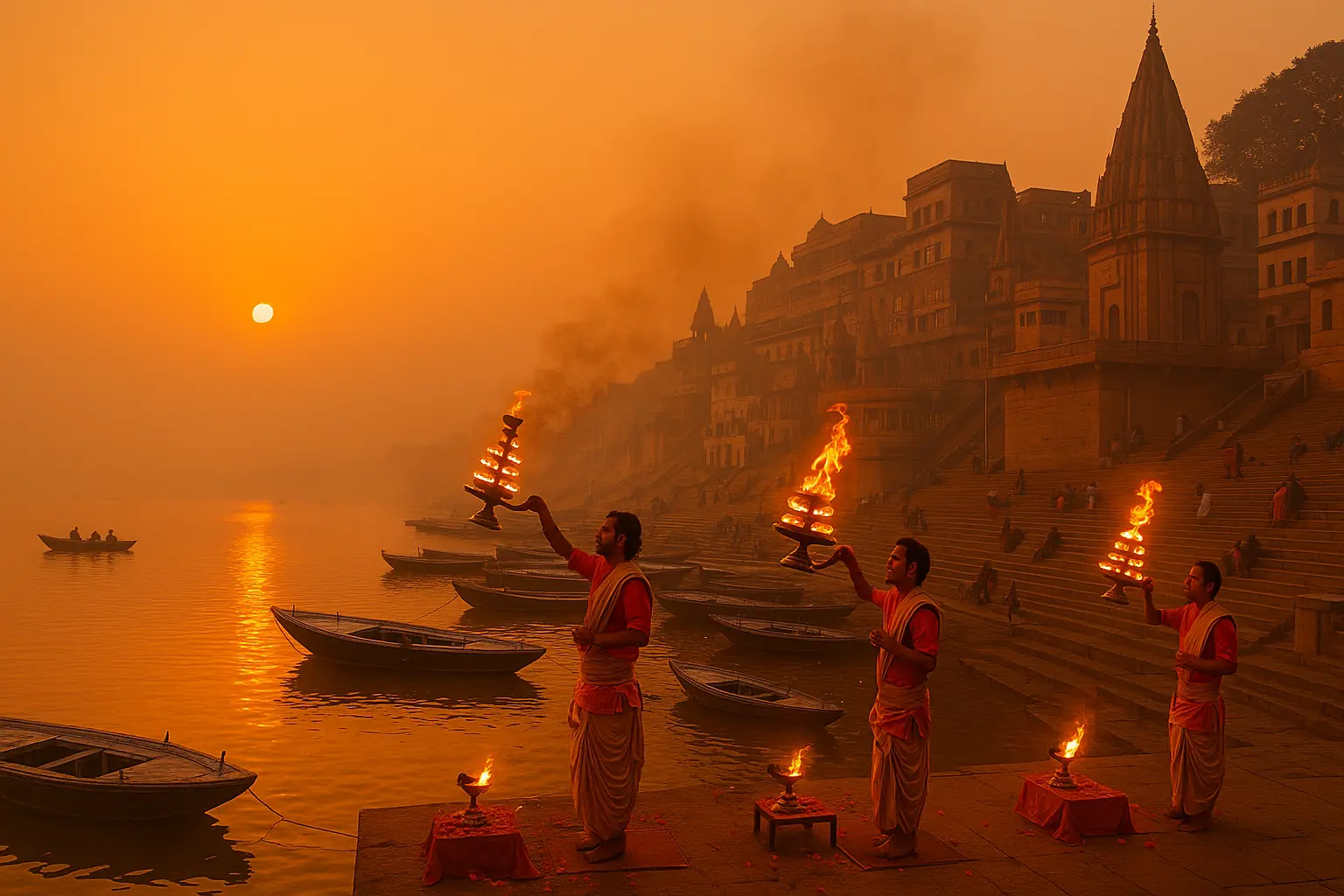
As dusk falls, the Ghats erupt in flame and song. The Ganga Aarti at Dasashwamedh is less a ritual and more a confession written in fire, offering the city’s chaos, its sins and its beauty to the river and the lord in one luminous sweep. You need to stand there, in the crowd of a thousand strangers who all feel like old friends, to understand why Kashi is called the eternal city; where even death is just another form of pilgrimage.
Kedarnath – The Yogic Lord in the Snow
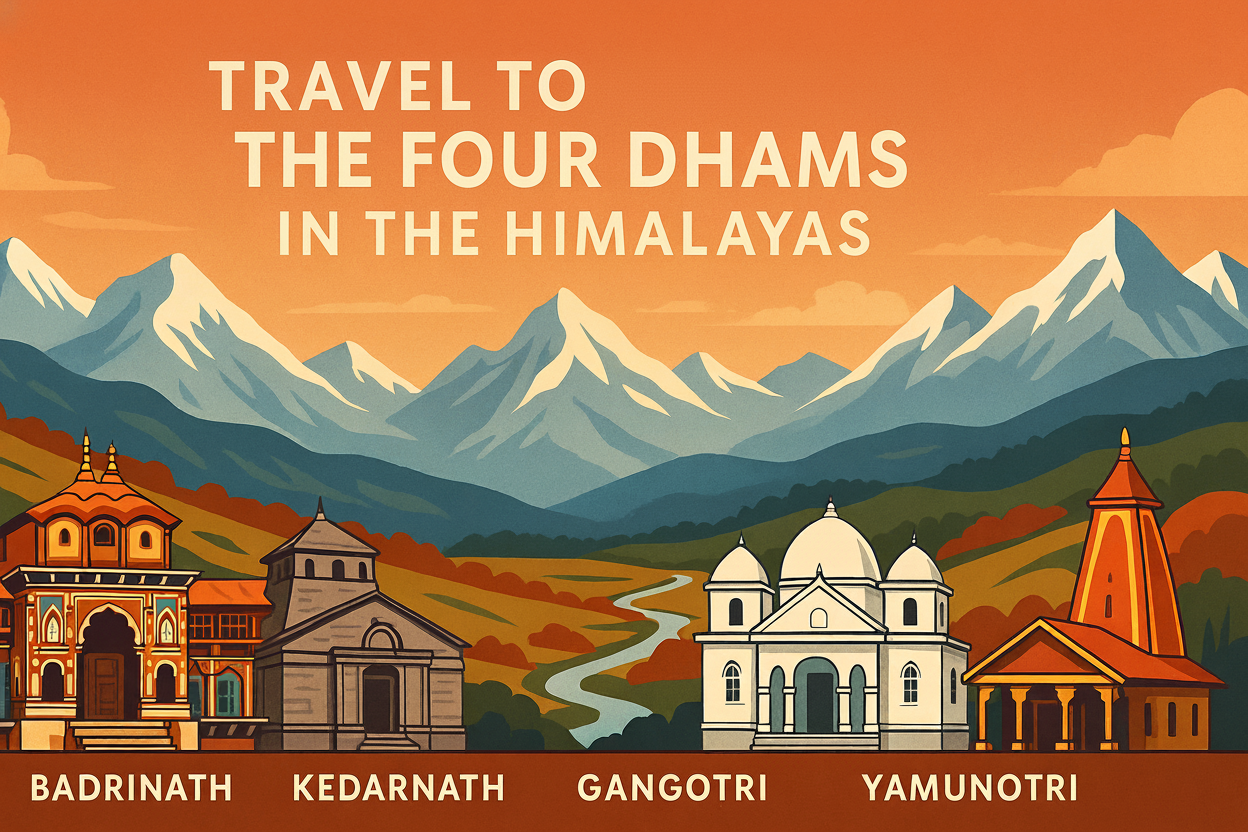
Located in the Himalayas, Kedarnath is one of the most sacred and difficult journeys. It is also said to be associated with the Pandavas.
High in the Himalayas, where the oxygen thins and the sky presses closer, Kedarnath Jyotirlinga appears as a stone fortress for the gods. The trek to the shrine is itself a metaphor: each step upward peels away a layer of comfort, until only the essentials remain—breath, focus, and a single prayer forming on the lips. The legend of the Pandavas seeking forgiveness after the war of Kurukshetra turns this mountain into a stage for moral reckoning, where even the mightiest heroes need mercy.
In the temple’s hush, broken only by the far-off creak of ice and the chime of bells, pilgrims frequently sense they’re teetering between two realms: one of stone and frost, the other of narrative and recollection. For countless individuals, this marks the northernmost reach of the Jyotirlinga circuit, a place where the flesh grows weary, yet the spirit sheds its burdens.
South India: Where the Ocean Meets the Divine
Mallikarjuna – The Temple of Togetherness
Situated in the Nallamala Hills, it represents the divine union of Lord Shiva and Goddess Parvati.
In the forests of Andhra Pradesh, Srisailam holds Mallikarjuna Jyotirlinga in its arms, guarded by thick greenery and the soft murmur of the Krishna River. What makes this shrine special is the presence of both Shiva and Parvati as principal deities, turning the temple into a celebration of togetherness in the midst of austerity. Here, legends of Kartikeya and Ganesha weave around the main narrative, making the space feel like a family home where the divine is both stern and affectionate.
The hills encircling Srisailam are speckled with caves and vantage points, making the pilgrimage a journey of ascent in more ways than one. It’s a climb not just in elevation, but in the capacity for emotional growth, moving from the raw, unrefined landscape to the tranquil calm of the inner sanctum.
Rameshwaram – Where Ram Prayed for Shiva
This Jyotirlinga is linked to the Ramayana representing the spot where Lord Rama prayed to Shiva before proceeding to Lanka.
On the island of Rameshwaram, the ocean stretches endlessly, and the Rameshwaram Jyotirlinga sits at the meeting point of two great stories: the Ramayana and the tale of Shiva’s own self‑manifested linga. Tradition says that Lord Rama, after the war with Ravana, came here to worship Shiva and seek atonement for the sin of killing a Brahmin, even if that Brahmin was a demon king. The temple’s long corridors and numerous tirthas—sacred wells and tanks—turn the darshan into a ritual marathon, where every step is a small act of surrender.
The island’s geography adds poetry: the Pamban Bridge, the wrecked town of Dhanushkodi, and the visible bend of the sea toward Sri Lanka. Standing there, pilgrims taste the edge of the subcontinent, where land ends and myth begins, and where the southernmost Jyotirlinga quietly closes the great circle of India’s spiritual geography.
Pilgrimage as Story: Planning Your Regional Saga
If the 12 Jyotirlingas are a novel, then reading them regionally is like appreciating each chapter in its own light:
- West India Volume: Somnath’s ocean, Nageshwar’s coast, and Maharashtra’s forest‑river‑cave trio make a journey that feels like a coastal and mountain romance, complete with ghats, ghats, and ghats.
- Central India’s heart beats in Ujjain’s Mahakaleshwar, flows through Omkareshwar’s Narmada, and finds solace in Deoghar’s Baidyanath. This trio forms a raw, contemplative core, a place where the relentless passage of time, the power of the river, and the promise of healing converge.
- North India’s landscape offers a striking juxtaposition. The bustling energy of Kashi, with its never-ending activity, stands in stark contrast to Kedarnath’s serene, Himalayan quietude. This blend of the human and the divine creates an ideal setting for contemplative, unhurried exploration.
- South India Volume: Srisailam’s forested hills and Rameshwaram’s island‑temple‑ocean blend turn the final chapters into a lyrical, almost cinematic finale.
Religious Significance of Visiting the 12 Jyotirlingas
- Embodies a complete spiritual journey around India
- Each Jyotirlinga represents a unique form of Lord Shiva
- Helps overcome fear of death and rebirth
- Inspires humility, devotion, and self-control
Many devotees undertake the Jyotirlinga Yatra at least once in their lifetime.
Best Time to Visit the Jyotirlingas
- Mahashivratri: Most sacred night to worship Shiva
- Shravan Month: Most pious time of the year
- Winter Months: Best time to visit Himalayan shrines like Kedarnath
It is always advisable to plan a region-wise trip to cope with climatic and crowd-related issues.
The 12 Jyotirlingas are more than just a pilgrimage site. They are infact vibrant hubs of faith, history, and cosmic power. Each of these sites has their own story of devotion, destruction, and rebirth. They collectively represent a spiritual map of India, leading one to self-realization and ultimate truth.
The Jyotirlingas are always a source of light for Shiva devotees, symbolizing where the infinite meets the finite.