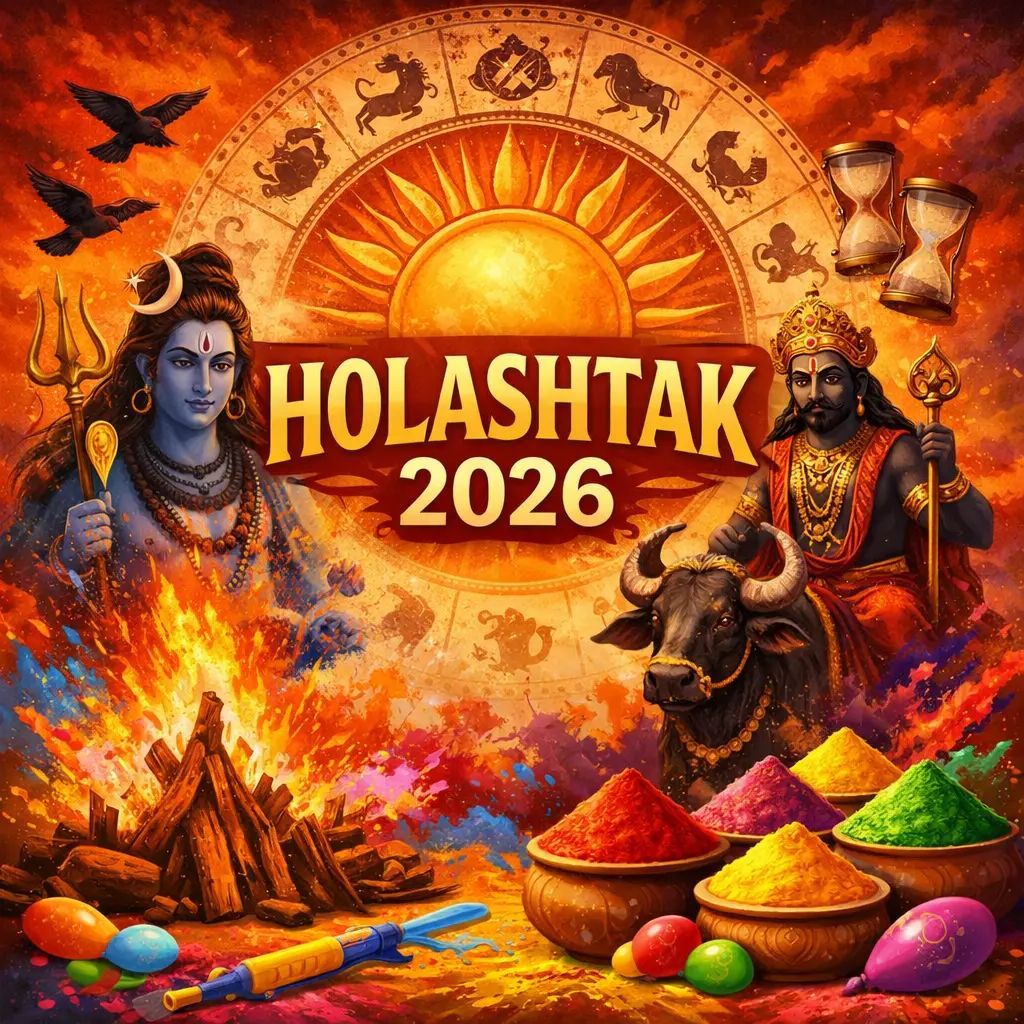
In the sacred geometry of the Hindu liturgical calendar, the period of Holashtak represents a significant chronological and spiritual threshold. Preceding the vibrant festivities of Holi, Holashtak is a window of eight days characterized by a distinct shift in cosmic energy. Derived from the union of “Holi” and “Ashtak” (signifying the number eight), this period is traditionally regarded by the Shastras as a time of Ashubha (inauspicious) planetary influence, necessitating a tactical withdrawal from worldly celebrations. Rather than viewing this as a period of mere restriction, the Vedic historian recognizes it as a vital phase of Sadhana; a time to internalize one’s focus and fortify the spirit before the ritual purification of the spring bonfire. This eight-day observance begins on the eighth day of the waxing moon and concludes with the transformative fire of Holika Dahan, a timeline that carries specific astronomical weight in the year 2026.
Chronological Timeline and Astronomical Context for 2026
The observance of Vedic rituals is never arbitrary; it is meticulously synchronized with the Tithi (lunar phases) to ensure alignment with celestial rhythms. The commencement of Holashtak is dictated by the arrival of Phalgun Shukla Ashtami, the eighth day of the bright fortnight in the month of Phalgun. In 2026, the specific window for this spiritual pause is defined by the following calendar:
| Event | Date (English Calendar) | Lunar Phase (Tithi) |
| Start of Holashtak | February 24, 2026 | Phalgun Shukla Ashtami |
| End of Holashtak | March 3, 2026 | Phalgun Purnima (Full Moon) |
| Holika Dahan (Ritual Fire) | March 2, 2026 | Pre-Eclipse Adjustment |

The 2026 cycle presents a particular challenge for the practitioner due to the occurrence of a Grahan (Lunar Eclipse) on March 3rd. According to ritual protocol, a Grahan creates a period of spiritual impurity (Sutak), during which the performance of sacred fire rituals is strictly prohibited. Therefore, while Holashtak officially concludes on the 3rd, the pivotal ritual of Holika Dahan must be moved forward to March 2nd. This adjustment ensures the ritual fire is ignited in an auspicious window, avoiding the spiritually counterproductive energies of the eclipse. These dates serve as a modern resonance of an ancient eight-day window of persecution that defined the ultimate triumph of faith.
The Mythological Origins | The Trial of Bhakt Prahlad
In the Vedic tradition, narratives are not merely stories but foundational precedents that establish cultural Samskaras (impressions). The restrictions of Holashtak are deeply rooted in the harrowing trial of Bhakt Prahlad, the young devotee whose unwavering faith challenged the tyranny of his father, the demon-king Hiranyakashipu.
According to the source tradition, Hiranyakashipu spent these specific eight days subjecting Prahlad to escalating levels of torture and psychological pressure, attempting to force him to renounce his devotion to Lord Vishnu. Throughout this Ugra (fierce) period of persecution, Prahlad remained immersed in constant remembrance of the Divine, demonstrating that true Sadhana remains unshaken even under duress. This cosmic conflict reached its resolution when Lord Vishnu manifested as Lord Narasimha—the divine avatar who is neither man nor beast—to destroy the tyrant and safeguard his devotee. This intervention establishes the “So What?” of the observance: we pause our worldly joys to honor the endurance of the devotee and the protective power of the Divine. The historical suffering of Prahlad during this window is why we treat these eight days as a time of solemnity rather than celebration.
Behavioral Restrictions: Prohibited “Manglik” Activities
During Holashtak, the atmosphere is considered heavy with the memory of Prahlad’s trials and the fierce energy of the impending transition. Consequently, activities classified as Manglik—those auspicious life milestones intended to bring long-term prosperity—are strategically paused. To initiate a major life event during this time is to risk the influence of Ashubha energies.
The tradition dictates that the following activities should be “completely stopped” (poori tarah se band) during this eight-day period:
- Marriage and Betrothals (Vivah/Byah): The union of two souls is a sacred Samskara that requires peak auspiciousness; thus, no weddings are conducted.
- Housewarming Ceremonies (Griha Pravesh): Consecrating a new residence and establishing its energy is deferred to avoid negative foundational influences.
- Tonsure Ceremonies (Mundan Sanskar): This vital purification ritual for children is paused until the energetic atmosphere clears.
- Baby Showers (Godh Bharai): Celebrations of new life and the protection of the womb are not held during this intense period.
- Commencement of Exams or Major Competitions (Pariksha): It is specifically the start or formal initiation of significant academic or professional challenges that is discouraged. While ongoing study is permitted, the “Muhurta” for beginning a new competitive endeavor is considered unfavorable.
By adhering to these restrictions, the practitioner acknowledges the priority of spiritual alignment over material advancement, shifting the focus from external milestones to internal resilience.
Spiritual Reflection and the Transition to Holi
Holashtak is far more than a period of “thou shalt nots”; it is a vital phase of internal consolidation. As a Vedic Cultural Historian would emphasize, the value of this period lies in the contemplation of the victory of Bhakti (devotion) over tyranny. It is a time to reflect on the strength of Prahlad and the inevitability of divine justice.
The transition from Holashtak to Holi represents a metaphysical crescendo. As the period concludes, the ritual fire of Holika Dahan—carefully scheduled in 2026 to avoid the Grahan—serves a profound purpose: it does not merely mark the end of the restrictions, but effectively burns away the negativity and suffering of the preceding eight days. This purification clears the path, transforming the Ugra energy of the past week into the joyful, vibrant celebration of Holi. Through this observance, we ensure that when we finally step into the festivities, we do so with a spirit that has been cleansed, fortified, and fully aligned with the Divine.