Navratri, which means nine nights in Sanskrit, is one of the most important and colorful festivals in Hinduism. It is a time for deep spiritual reflection, lively dance, and honoring Shakti, the divine feminine energy. Many people know about the big celebrations that happen in the fall, but Navratri happens several times a year, each with its own special spiritual significance.
The Four Navratris
Most practitioners are surprised to learn that there are actually four Navratris in a lunar year, though only two are celebrated on a massive public scale.
- Sharadiya Navratri: This is the most well-known celebration that takes place in the lunar month of Ashvin around September to October. The celebration ends with Dussehra also known as Vijayadashami to celebrate Goddess Durga’s victory over the demon Mahishasura. Following the same the devi was named as Mahishasurmardini.
- Chaitra Navratri: It is celebrated in the spring season around March–April. The ninth day is Rama Navami, which is the birth of Lord Rama. This is the also the beginning of the Hindu New Year.
- Magha and Ashada Navratri (Gupt Navratris): These are secret Navratris that spiritual seekers and Tantra practitioners mostly celebrate. They focus on internal rituals and worshiping the ten Mahavidyas (wisdom goddesses).
Regional Celebrations
Differences by Region Navratri is a great example of unity in diversity because each part of India sees the festival through its own cultural lens.
The East: Durga Puja
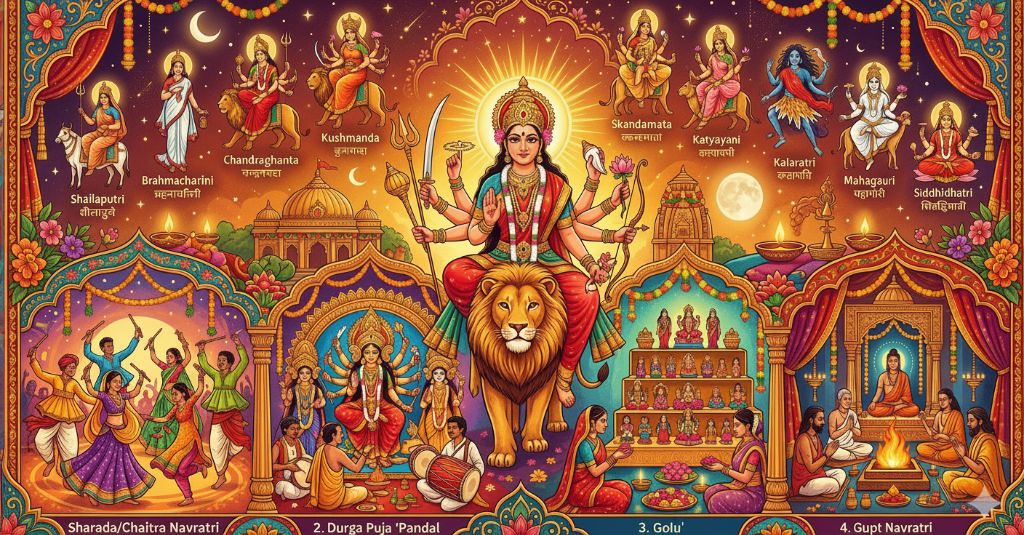
In West Bengal, Odisha, and Assam, the final five days are celebrated as Durga Puja. Massive, intricate Pandals (temporary shrines) are built to house life-sized idols of the Goddess. It is a time of feasting, art, and the rhythmic beat of the Dhak drums.
The West: Garba and Dandiya
In Gujarat and Maharashtra, the festival is all about dancing. Thousands of people gather in circles to do Garba and Dandiya Raas, moving in patterns that show how time and life are always changing.
The South: Golu and Bathukamma
In Tamil Nadu and Karnataka, families make Golu, a tiered display of dolls that represent gods and daily life. In Telangana, women celebrate Bathukamma by making beautiful flower stacks to honor the goddess Gauri, who gives life.
The North: Ramlila
In Northern India, the Ramayana is often the main focus. For nine nights, dramatic reenactments of Lord Rama’s life (Ramlila) take place, and on the tenth night, huge effigies of Ravana are burned.
The Symbolism of Nine days
Each day of Navratri is dedicated to one of the nine forms of Goddess Durga, also known as the Navadurga.
| Day | Avatar | Significance |
| 1 | Shailaputri | Daughter of the Mountains; represents nature and grounding. |
| 2 | Brahmacharini | The ascetic; represents penance and wisdom. |
| 3 | Chandraghanta | The brave; represents peace, serenity, and courage. |
| 4 | Kushmanda | The creator of the universe; represents energy and light. |
| 5 | Skandamata | The mother of Skanda (Kartikeya); represents maternal love. |
| 6 | Katyayani | The warrior; represents the destruction of evil. |
| 7 | Kalaratri | The fierce form; represents the destruction of darkness/ignorance. |
| 8 | Mahagauri | The radiant; represents purity and tranquility. |
| 9 | Siddhidhatri | The giver of boons; represents spiritual perfection and bliss. |
Rituals and Traditions
Even though customs differ, there are some things that everyone does during the celebration.
- Fasting: Many devotees fast by not eating grains, onions, or garlic and instead eating Navratri vrat foods like fruits, milk, and Others.
- Ghatasthapana: The ceremonial setting up of a pot (Kalash) on the first day to show that the Goddess is there.
- Kanya Puja: On the eighth or ninth day, young girls are invited into homes and worshipped as living representations of the Goddess. They are provided with food and gifts.
Did you know that each day of Navratri has a different color? Devotees often prefer to wear clothes that match the color of the day, from royal blue to peacock green, to connect with the energy of that day’s deity. Check Out Our Navratri Colour Guide to Know the colours of 9 days of Navratri.
Navratri Frequently Asked Questions
Here are the most common questions regarding the Navratri festival, its rituals, and its cultural importance.
Ques: Why is Navratri celebrated twice (or four times) a year?
Ans: There are four Navratris in total celebrated around the change of seasons. The most important ones are Chaitra Navratri (Spring) and Sharadiya Navratri (Autumn). The Navratri also marks the start and end of big changes in the seasons. People believe that these are conjunction points spiritually, when the Earth’s energy is very open to spiritual practices and cleansing.
Ques: What is the difference between Chaitra Navratri and Sharada Navratri?
Ans: Chaitra Navratri is celebrated around March and April announcing the beginning of the Hindu New Year (Lunar calendar). It ends with Rama Navami. On the Other Hand, Held around September and October Sharadiya Navratri celebrates the Goddess Durga’s victory over Mahishasura. It ends with Dussehra.
Ques: What are the Gupt Navratris?
Ans: During the months of Magha (January-February) and Ashada (June-July), there are secret Navratris. They are called secret because people don’t usually celebrate them with public parties or dances. Instead, Sadhus, Tantriks, and serious spiritual seekers meditate and pray to the Das Mahavidyas.
Ques: Can I eat grains during Navratri fasting?
Ans: No, you can only eat Sattvic foods during Navratri Vrat fasting. These foods including Kuttu ka Atta (Buckwheat flour, Singhare ka Atta (Water chestnut flour), Sabudana (Sago/Tapioca pearls) Makhana (Fox nuts), fruits, and dairy products.
Ques: What is the significance of the Kanya Puja (Kanjak)?
Ans: Usually held on the eighth (Ashtami) or ninth (Navami) day, Kanya Puja is a ceremony in which young girls (usually under 10) are worshipped as living representations of Goddess Durga. Their feet are washed, and they are given special food (usually halwa, puri, and chana) and gifts as a sign of respect for the divine feminine energy.
Ques: Why are there specific colors for each day of Navratri?
Ans: The nine colors represent the specific qualities of the nine forms of Durga also known as Navadurga. Many devotees wear the color of the day to harmonize their personal energy with the deity being worshipped.
Ques: Is Navratri celebrated the same way across India?
Ans: No, the beauty of Navratri comes from the fact that it is different in different parts of India. For example, in the West, people do Garba and Dandiya dances, while in the East (Bengal), they do Durga Puja. In the North, they do Ramlila plays, and in the South, they worship flowers and make Golu dolls.